Blindness and Disability, Samples, Writing

Albino – Seeing and Not Seeing 2

When I was maybe five years old, my mom was convinced I couldn’t smile right. I studied her mouth as intently as I could, then stretched my own into the same shape. But one lip or the other was always too high up, too pulled down, turned too far in or out. I tried to work these corrections into my face muscles but I could never see my mom’s smile in enough detail to craft my own to look like everyone else’s.
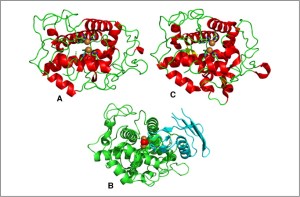
Crystal Structures of Tyrosinase

I have albinism, a recessive genetic condition that results in skin, hair and eyes that are paler than pale, and legal blindness. An enzyme called tyrosinase that converts the amino acid tyrosine into melanin pigment is inactive in albinism and this leads to the whiteness and blindness. The visual impairment of albinism, though steady and consistent, is murky territory—I’m too blind to drive or read any of the letters on a standard eye chart except that top “E” but not so blind that the world isn’t intensely, sensually, visual. In the blind community, I am what they call a “high partial.”

Around the same time as smile training, my blindness was a dull but ever-present emotional ache. On the playground, kids ran up to me and called out “whitey” and “snowball” and “ghost,” waved their hands in the air and asked me how many fingers they were holding up, mimicked my ambling eyes. As I got older, the teasing involved spitballs, a kid who jumped out in front of me in the hallways and yelled, “Watch out, brick wall!” and the boys in eighth grade who stole books out of my locker and set them on fire.

Sometimes, in my room, away from the teasing by my peers but alone with the scenes replaying in my head, the ache would erupt into a scalding, white-hot rage. It was so unfair that out of all the people I knew in my family, in school and around town, I was the one who ended up albino. No one saw anything beyond my albinism. I felt like a ghost.

~~~

Another sample from my essay “Seeing and Not Seeing.” Here’s the previous excerpt from the same essay. I have to say, this piece above is the very beginning. The essay doesn’t end in this same place or mindset.

~Chrys
Samples, Writing

Lead Us Not Into Temptation

LeadUsimagesI poked my brother sitting beside me. “Pssst, we only have fifteen more minutes,” I whispered. He pretended not to notice but I could see the smile on his face and knew he was glad that Junior Sunday School was almost over. I played with my pigtails, pretending to scratch my ear. Then I poked Davey again. “I guess Anne’s the favorite today,” I whispered. He still wouldn’t look at me but he stuck out his lower lip.

“Elizabeth, that’s enough! Stop disrupting your brother and start paying attention right this very minute!” Mrs. Ross’ voice was high and shrill, and she had a snarl on her face. I gave her a nasty look back. “And quit it with the pouting or you’re in big trouble, missy.”

She shifted Anne from one knee to the other and went back to reading us her Bible story. I growled under my breath. Anne lived next door to us. We walked to our first grade class together every day and she yelled at me because I played with flowers in the fields and chased the neighbor’s dog. “Lizzy, we’re going to be late,” she’d say like the whole world was going to end if we were late by even one little second.

I always said, “Then go ahead alone and be a goody-two-shoes,” but she never did. She stayed and waited while I climbed trees and picked dandelions and rubbed them on her arm and made up songs about the clouds. We were never late ever, I always looked at my Little Mermaid watch and made sure we had enough time to make it just before the bell. I liked to give Anne a scare.

~~~

This is an excerpt of a fiction story called “Lead Us Not Into Temptation” about kids who test the scary stories their Sunday School teacher tells them. I’m never sure exactly hwo to classify this one. The main characters are really young, so it could be thought of as a children’s story but I never really think of it that way.

~Chrys

Samples, Writing

What Color is Your Eight? – On Synesthesia 1

The color of the number 8 is a purply violet-black but not a bright violet, more dull. It’s almost more of a vibration than a color. August is similar but darker, almost burnt and yet more radiant. The letters D and P are both green but D is pale sage while P is an intense forest green. Tuesday is a muted cerulean blue.

Regions thought to be cross-activated in graph...
Regions thought to be cross-activated in grapheme-color synesthesia

Synesthesia is a condition in which one sense evokes another, habitually and involuntarily. Some synesthetes sense different tastes with musical keys, feel “personalities” for different days of the week, or perceive months as having specific spatial locations (“November is two feet to the right”) but the most common form is color-grapheme synesthesia, where letters and numbers have immediate, unchanging color associations. This is the form of synesthesia I experience, as well as colors for months and days of the week that in some cases do, and in some don’t, relate to their letters or numbers.

In his bestselling Musicophilia: Tales of Music and the Brain, Oliver Sacks explores synesthesia, musical and otherwise. He describes psychologist Patrick Ehlen’s early experience of saying aloud to his first-grade class that he was “counting the colors until Friday,” to which the class burst out laughing.

One day in third grade, my class was talking about colors and feelings. The teacher asked everyone what color we thought anger was and everyone said “red.” Of course it was. Vowels and first letters set the tone for the word and A is a rich, deep red. Then she asked us what color sad was, and the rest of the class said “blue” as I started to say “red.” Sad has that deep red A and the S, a duller shade of red. Most people thought of being sad as “having the blues,” but for me it was as deep a red as melancholy. It was the first time I remember being conscious that others didn’t see these colors.

~~~

This is an excerpt from “On Synesthesia,” a lyric essay I wrote about, you guessed it, synesthesia.

You can check out other Friday Samples here. And don’t forget you can always check out Published and Older Works for more samples.

~Chrys

Next Up: Legends, Fakers and Painterly Writers – On Synesthesia 2

Samples, Writing

Ocean Reverie

Long Island Sound, Connecticut

I am obsessed with the sea. This river isn’t that, but it stretches out for eons. I gaze at the horizon, misty and distant. My parents grew up in Connecticut and I was born in a small town right outside of New Haven, only a five-minute drive from the shore. Long Island Sound, I think, shaped me more than I can remember. I have vague blurry childhood pictures of being at the beach when I was little, walking down a woodsy road with a yellow line in the middle and thick trees on the sides, until we reach a little wooden shack with stalls where we could change. In other still photos I see Mom showing me how to listen for the ocean in a conch shell, talking about seahorses during a sunset, walking along the shore combing for smooth rocks, shells or colored glass. My life was colored with the scent of saltwater until just before I turned six.

We were eating McDonald’s food for lunch the day Dad told us he got transferred. I still remember the taste of the salty fries in my five-year-old mouth after he told me and Randy, we’re moving. I didn’t think I much cared. We traveled often enough, all over New England, to Santa’s Village in New Hampshire and other amusement parks in Massachusetts and Vermont. My dad used to be a policeman, and oftentimes he had to work nights, but it seemed like we always had time for vacations. Then Dad decided to join the FBI and had to go to a place called Quantico for sixteen whole weeks. That McDonald’s lunch—a special treat reserved for special occasions—was so soon after his return. We moved to Buffalo at the end of that January, while Mom was newly pregnant with June.

And it’s true what they say sometimes in books and movies and in that old song, “Big Yellow Taxi,” done originally by Joni Mitchell, you really don’t know what you’ve got until after it’s gone. There is no way to calculate how much something means to you, especially when it’s something you always see, something you live with every day, like a nearby ocean and a nearby Nana. Those things creep up on you, so invisible and insidious until they’re a part of you that you can’t live without.

Continue reading “Ocean Reverie”

Metaphysics, Samples, Writing

The Colors – Dark As Roses 1

I look around the classroom and try not to see anyone. I should pay attention to the psychology book on my desk—after all, the midterm is on Friday and it’s now Monday—but the words blur and swim on the page. At the board, Dr. Crowley goes on, reviewing the abnormal cases. Pretty soon he’ll bring up synesthesia and I’ll melt into a puddle of mush on the floor and die. In the meantime, I suppose I’ll stare at the wall. I can’t look at my classmates, I’ll only see the colors. Won’t even be able to see the faces for all the haze brought on by midterm worry. I’m going mad, I know.

Dark Rose

I’ve always seen the colors around the people, even as a very small child. Most of the shrinks my mom dragged me to back then chalked it up to synesthesia, said there was some odd wiring in my brain that confused my senses and that’s why I saw colors. They always did remark though, that it’s a very focused case. Usually people with synesthesia hear sound when they see motion or associate colors with certain letters and numbers, whereas I only saw the colors on the people. My classmates used to tease me about being the crazy girl in town, after I made the grave mistake of talking about it. Frustrated teachers tried to educate them about my affliction, as they called it, about the wiring gone wrong in my brain. That only made them laugh until they were sick with giggles. They called me “Metalbrain.”

Now it’s my second year away at college and no one knows about my problem. I don’t want Dr. Crowley talking about my affliction in the class. I might concentrate too hard on the professor, or the floor, or this wall I’m staring at. I might nervously twirl my hair or fidget and then everyone will know my secret.

~~~

Today I decided to go with some fiction. “Dark As Roses” is a short story I wrote about a girl who struggles with psychic ability she’s not sure she wants to possess. These are the first few paragraphs.

You can check out other Friday Samples here. And don’t forget you can always check out Published and Older Works for more samples.

~Chrys

Next Excerpt: Psychedelic Strobe Lights – Dark As Roses 2

Blindness and Disability, Samples, Writing

Reading Eyes and Faces – Seeing and Not Seeing 1

eyeimagesAnd faces—nothing has given me more trouble. Eyes, those most important details of a face, are too small to make out unless I am close enough to make out with someone. I didn’t know what color my last boyfriend’s eyes were until after we had been dating for almost six months. Whenever we were close enough for me to discern their color, he kept his eyes closed. I didn’t see his eyes until we were riding a city bus on our way to a concert on an early May evening, squished next to each other on the seats. He turned slightly to me, the light was just right, and I finally saw out of my right eye that his left was brown with textured traces of gold, simultaneously soft and hard in color.

Last year, I was watching TV on my 24-inch computer monitor, sitting less than a foot away, and saw a close-up of someone rolling her eyes. At thirty, I was seeing that gesture for the first time and it was nothing like I had imagined. Inspired, I wanted to get a glimmer of what it is to read feelings in eyes, so I watched Grey’s Anatomy, scrutinizing characters during emotionally wrought scenes, their faces taking up my whole screen. Though I felt all the feelings from the context, the music, the minute changes in pitch and inflection in their voices and the larger facial gestures, I could see nothing in the eyes.

~~~

This is an excerpt from an essay in which I explore a few different aspects of albinism and blindness.

You can check out other Friday Samples here. And don’t forget you can always check out Published and Older Works for more samples.

~Chrys

Blindness and Disability, Samples, Writing

Possibilities – Blind Conventions 1

NFB Convention, Detroit 2009

The first few days of convention are filled with Division meetings, meaning that instead of meeting as a huge assembly (that will come later), at any given time there are several different special interest groups meeting at once. Parents of blind children, blind parents, seniors, diabetics, piano tuners, ham radio operators, lawyers, antique car enthusiasts, crafters, technology buffs, they all have divisions and meetings. There are also meetings for new members, presentations from different schools for the blind, presentations by guide dog schools where you can “test drive” a guide dog, meetings on how to build up local chapters, demos of new adaptive technology, plays put on where the directors and actors are all blind, salsa dance classes taught, attended and deejayed by blind folks, a mock trial put on by blind lawyers and the list goes on. We take frequent breaks in our room because the stories are true, it is a little overwhelming.

There’s also the Independence Market, a technology and adaptive aid exhibit hall in one of the hotel ballrooms and it is something to behold. Along every inch of every wall, and through several makeshift hallways in the center, there are endless tables and displays, each draped in a different company logo. Most of the booths feature technology items—braille notetakers, digital book readers, screen-reading software packages, handheld iPhone-shaped gadgets that act as magnifiers and also play music and videos. Apple is there with the real iPhones, which are accessible right out of the box, the new technology rage among the blind. There are several flavors of talking medical supplies, every size and shape of magnifier and audible GPS devices. There are random non-techie booths, like the FBI doing job recruiting, and a booth selling Braille Bibles brailled in over 27 languages, including several Indian ones like Hindi and Malayalam.

I go by myself to the science and engineering division meeting, where I meet people who are interning for NASA and a totally blind girl who’s majoring in biochemistry who guesses people’s heights (while they are sitting down) by voice. Even though I’m slightly slouching, she guesses my 5’7” spot on. The NASA thing gets me. When I was younger, I thought I wanted to do something like that when I grew up, but back then my visual impairment would have been a deal-breaker. That’s one of the great things about a convention like this: you get to really see that things are changing, that blind people are making inroads and finding success in all kinds of careers and hobbies.

~~~

This is an excerpt from the essay “Blind Conventions,” a recounting of my first experience at a blind convention held by the NFB. This piece is apropos because I’m currently en route to my 2nd NFB convention. I’m sure there will be lots of fun crazy, funny, weird and inspiring stories that I’ll be tweeting along the way! These conventions are always surreal.

You can check out other Friday Samples here. And don’t forget you can always check out Published and Older Works for more samples.

~Chrys

Blindness and Disability, Samples, Writing

My Face

I can’t read the nuances of faces but mine is a direct display of every undulation in my emotional current. My face is a one-way mirror.

Still, others often don’t see my personal, particular face.

People sometimes asked if my albino friend and I were twins. We were nine years apart and my face was longer, drawn while hers was rounder, more full. Worse yet, at an albinism conference, my dad came up to the girl next to me and told her it was time to go, mistaking her for me.

My face is at once expressive, transparent and invisible.

~~~

This is from a class I took called Personal Essay Writing. The assignment was to write about your face in EXACTLY 100 words. No more, no less. It led to a lot of obsessive editing.

You can check out other Friday Samples here. And don’t forget you can always check out Published and Older Works for more samples.

~Chrys