Blindness and Disability, Music, My Books, Writing

If You Are a Music Fan . . . You Might Like INVISIBLE VIOLETS

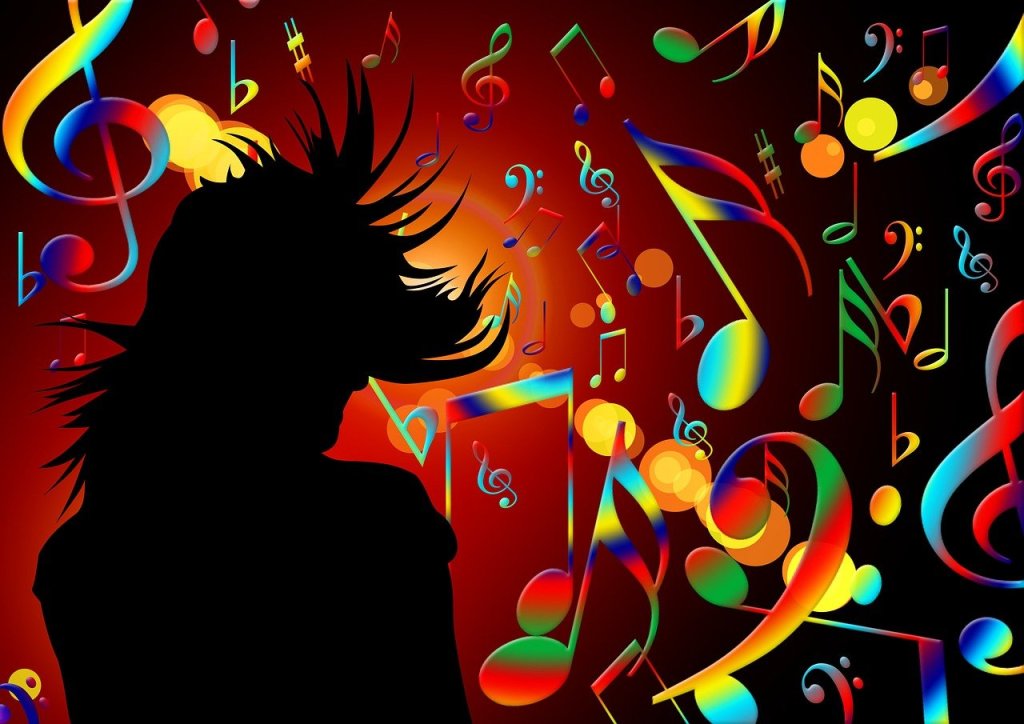
a silhouette of a person with hair flying like they're head banging, with music symbols in the background, including treble clefs, bass clefs, sharp symbols, flat symbols, and music notes.

If you know (and everyone you know knows) you talk about music too much . . .

If you ever had the urge to cover a driveway or sidewalk with chalk drawings of band logos, song names, and lyrics . . .

If you credit music for getting you through your toughest times and hardest heartbreaks . . .

If you frequently have the urge to blast music while driving (or while riding in a car if you’re like me and can’t drive) and sing along at the top of your lungs . . .

If you remember your life by what albums you were listening to when and understand your life through lyrics . . .

If you were the kind of kid who answered parental questions about how the latest visit to the doctor’s office went with what songs you heard while in the waiting room . . .

If you love the 60 Songs that Explain the ’90s podcast (now 60 Songs that Explain the ’00s) or would listen to a similar podcast for your specific favorite music decade . . .

. . . then my forthcoming debut book, INVISIBLE VIOLETS: A Mixtape in Lyric Essays is a book for you. It’s a memoir in 7 essays with a few different themes running through its tracks (essays).

One of the strongest themes is disability (see this post about the disability aspect of the book), and as I write in Track 3: The Caduceus and the Muse:

Not all my writing, not even all my more personal writing, addressed albinism or disability, but I was constitutionally incapable of not writing about music.”

Music is all over this book. Obnoxiously so, even. Music was such a saving force in my life when I was young, and I hope my book evokes that particular sense of connecting with music as a teenager and how that resonates and evolves long after adolescence. How music can reach you when you’re an isolated and outcast kid in a way nothing else can reach you. How music can buoy you when you’re in your twenties and finding your way in the world. How music will always be with you, through all the ups and downs of adult life, as your tastes expand over time. I hope I’ve done a decent job of capturing something that feels beyond and before words.

Your particular favorite genres might be different from mine, and I hope that what I’ve written, while deeply specific, speaks to feelings that transcend genre. Still, you might be especially drawn to this book if you are or were a fan of ’90s rock, especially any of the many musical projects of Chris Cornell, to whose memory the book is dedicated. Almost every band that was on the Singles soundtrack is in the book. The artists and genres mentioned lean grunge and heavy and rock, and there’s also modern pop, singer-songwriter girlies across the ages, classic rock, and weirdly mentions of two very different artists doing covers of Joni Mitchell songs.

Again, though, my hope is that even when our specific tastes and faves differ, the feeling of the primacy of music that infuses this book will still resonate with you as you read.

I’m working on book playlists based on musical references and allusions in the book. One is a maximalist version that’s over the top, excessive, and 1.3 days long. The other is an abridged version that I’ve so far only been able to whittle down to 100 songs, which seems long for an abridged version but might have to stand as is. I’m also working on a word cloud of all the music in the book. So those will be incoming at some point before my book launch on March 13th!

Music as a theme is over-the-top, excessively prominent in these essays:
Track 3: The Caduceus and the Muse
Track 5: Can’t Change Me: An Unnatural History of My Names
Track 7: Distant Lights
Acknowledgments

Music as a theme is central in these essays:
Track 4: August is a Burnt Burgundy-Violet Haze
Track 6: Reasonable Doubt

Disability is present but more peripheral in these essays:
Track 1: Invisible Violet: On Seeing and Not Seeing
Track 2: Blue Alchemy
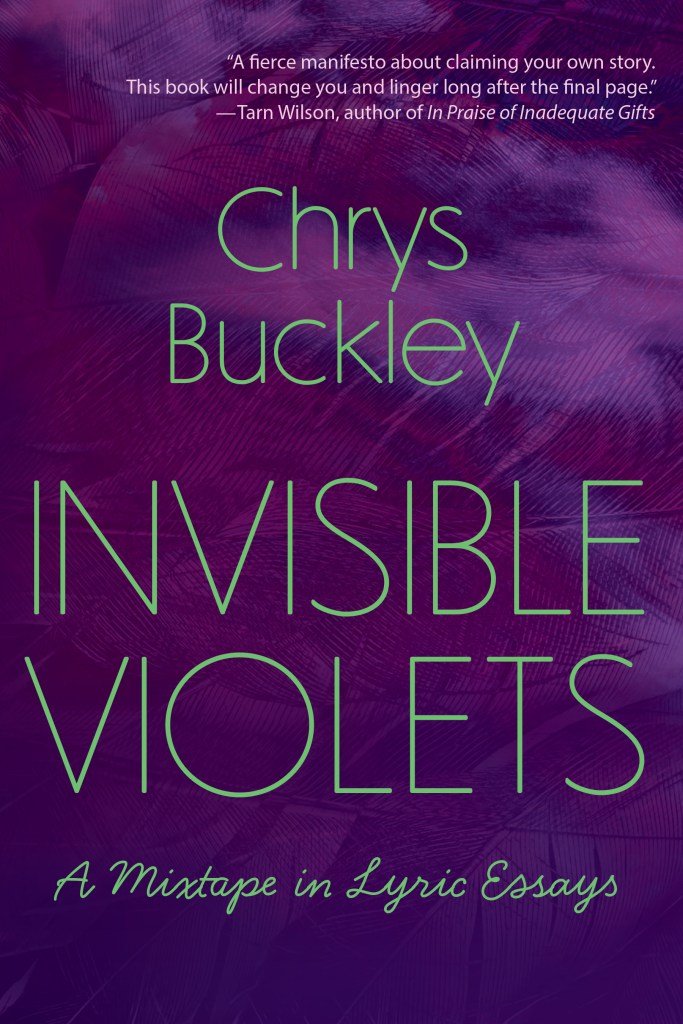
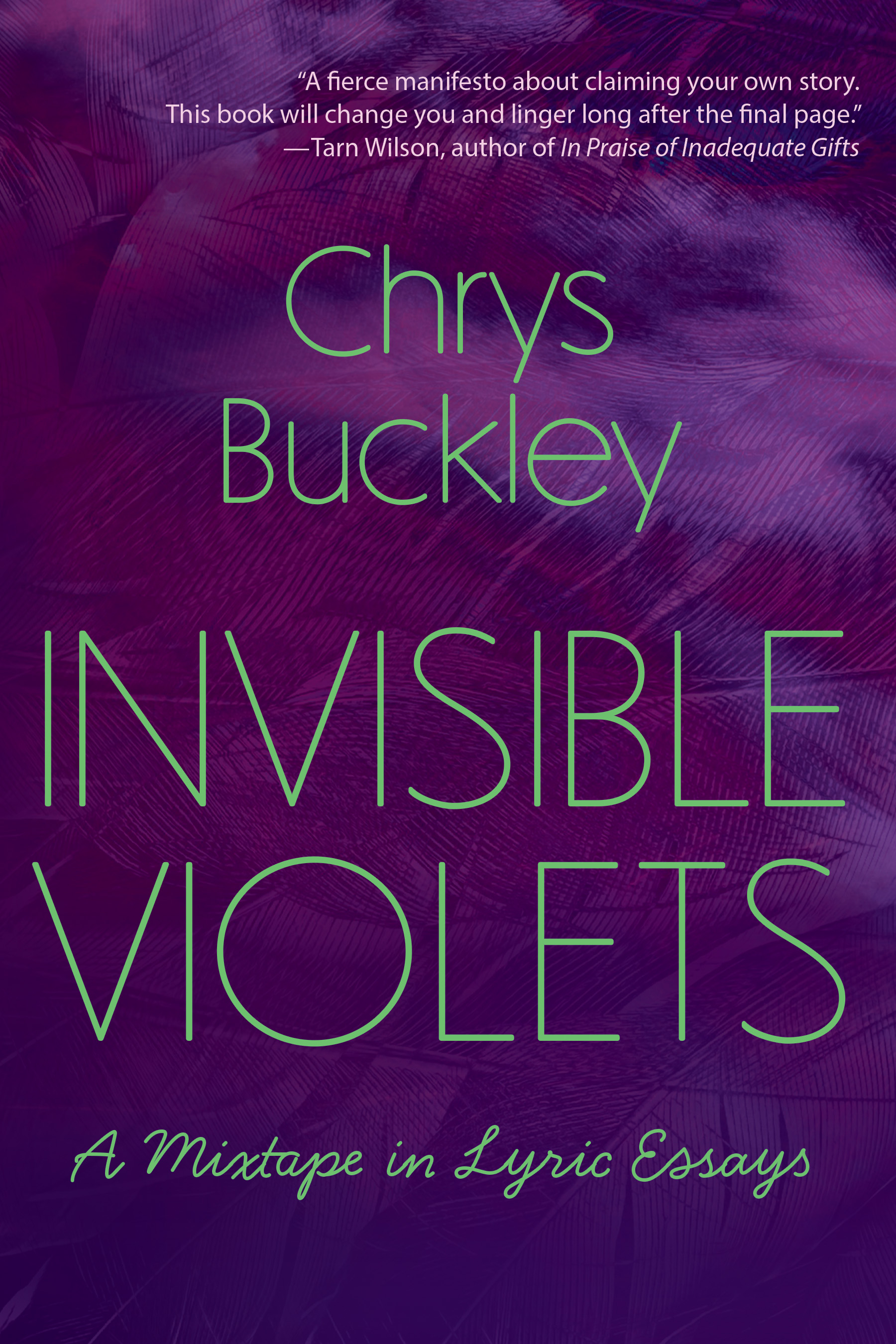
Cover image of Invisible Violets: A Mixtape in Lyric Essays by Chrys Buckley. Words are green against a textured background of different shades of purple. Near the top of the cover, there is an author blurb that reads, "A fierce manifesto about claiming your own story. This book will change you and linger long after the final page." This blurb was written by Tarn Wilson, author of In Praise of Inadequate Gifts.

~~~

For all the book details, check out the INVISIBLE VIOLETS page!

This post is part of a series, published the second Tuesday of every month, where I think about who my book is for.

~Chrys

Image Description: a silhouette of a person with hair flying like they’re head banging, with music symbols in the background, including treble clefs, bass clefs, sharp symbols, flat symbols, and music notes.

Blindness and Disability, Music, My Books, Writing

BACK COVER REVEAL!

First there was the COVER REVEAL.

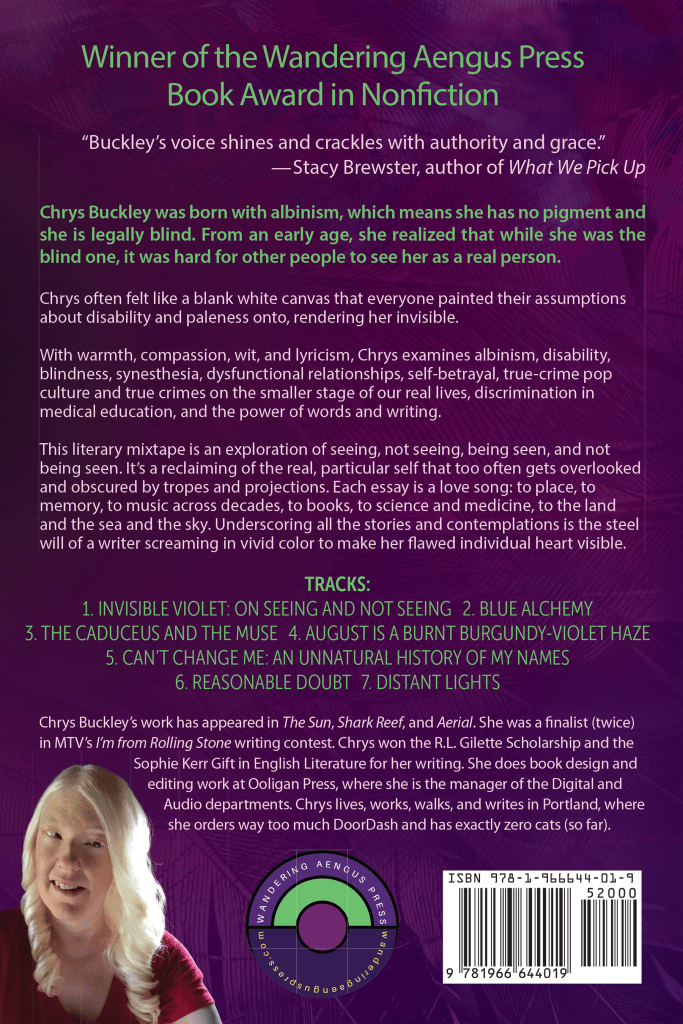
It’s been a minute since then (!) and now it’s time to reveal the back cover of INVISIBLE VIOLETS: A Mixtape in Lyric Essays! You can find book info, including how to pre-order signed and personalized copies here.

With no further ado, here is the back cover:

Back cover of Invisible Violets on a textured purple background
Blindness and Disability, My Books, Writing

If You Have a Disability . . . You Might Like INVISIBLE VIOLETS

array of accessibility icons, including wheelchairs, canes, guide dogs, pregnant people, and question marks for less apparent disabilities

Or if you are disabled.

Or if you’re a person with a disability.

Or if you are living with disability.

Or if you experience disability.

Or if you have lived experience of maybe sometimes possibly experiencing this thing in your life that we all must put lots of words in front of to make it as distant as possible that we maybe sometimes possibly in whispered voices refer to as disability.

Okay, I’m obviously getting a bit over the top with that last one (though it does sometimes feel that way). My point, though, is that no matter what language you use, you are welcome here and you might find resonance in my upcoming debut essay collection, INVISIBLE VIOLETS: A Mixtape in Lyric Essays.

I’ve been thinking a lot lately about who my book is for. It’s going to publish in two months, and so my thinking has had to shift more outward now that all the proofing is done and it’s on its way out into the world. (Yay! And eeeeeeeek!)

The most prominent theme running through my book is disability. So, if you are a disabled reader (or any other particular phrasing that feels right to you), this book is for you.

Even though we all experience disability differently (even if we have the same disability), I hope my words will give you that “oh yes” and “she gets me” sense while reading, a sense I’ve experienced while reading authors who have disability in common with me.

I hope my words will give voice to internal and external dynamics in a way that articulates the specific struggles and joys of disabled life in a way that makes you feel seen and understood, as other books have done for me.

I hope reading my book lights a fire under the part of you that wants to write your own story, if you’re so inclined, because there are so few books about disability by disabled people out there and there’s room for so many more, and we need more.

Not every essay in my collection has disability as its central topic. Sometimes it’s a central theme, and other times it isn’t. Because that reflects reality. Sometimes it’s all-consuming, and other times it’s more like background noise.

Disability as a theme is most prominent in these essays:
Track 1: Invisible Violet: On Seeing and Not Seeing
Track 3: The Caduceus and the Muse
Track 5: Can’t Change Me: An Unnatural History of My Names
Track 6: Reasonable Doubt

Disability is present but more peripheral in these essays:
Track 2: Blue Alchemy
Track 4: August is a Burnt Burgundy-Violet Haze

Our experiences won’t be exactly the same. They might even be wildly different. Either way, I hope there are lines and paragraphs and passages and perhaps whole essays that harmonize with your experience and give you that sense of recognition that sometimes comes with reading.

Cover image of Invisible Violets: A Mixtape in Lyric Essays by Chrys Buckley. Words are green against a textured background of different shades of purple. Near the top of the cover, there is an author blurb that reads, "A fierce manifesto about claiming your own story. This book will change you and linger long after the final page." This blurb was written by Tarn Wilson, author of In Praise of Inadequate Gifts.

~~~

For all the book details, check out the INVISIBLE VIOLETS page!

~Chrys

Image Description: an array of accessibility icons depicting people in wheelchairs, people using canes, people with guide dogs, pregnant people, people with small children, and some questions marks (which I believe represent less apparent disabilities).

Blindness and Disability, Music, Writing

COVER REVEAL!

The time is here. After rounds of editing, eproofs, print proofs, and another round of proofs, the book is locked in.

I spent all summer going over my book for what felt like a bajillion times. In fact, if I had to read any of it right now, I’d probably run away screaming because I’m SO SICK OF MY BOOK! Good thing there’s a fair amount of time until launch day (March 13th) so it can feel fresh again by then.

In the meantime, now that it’s all locked in, here is the cover:

Cover image of Invisible Violets: A Mixtape in Lyric Essays by Chrys Buckley. Words are green against a textured background of different shades of purple. Near the top of the cover, there is an author blurb that reads, "A fierce manifesto about claiming your own story. This book will change you and linger long after the final page." This blurb was written by Tarn Wilson, author of In Praise of Inadequate Gifts.

It’s a typographic cover rather than an image-based one. One thing I’ve learned through this process and my work at Ooligan Press is that covers often look duller in print, and a lot darker. So stay tuned for future reveals. The back cover will be coming soon, and so will an unboxing video when the author copies arrive!

~Chrys

Blindness and Disability, Music, Science

“You’re Not My Homeland Anymore”

Or “So I’m Leaving Out the Side Door” Part Two

Since this post is a sequel to that one, I’m posting the lyric video again.

In “exile” from folklore, Taylor Swift and Justin Vernon of Bon Iver are singing to and about an ex-lover. For me, the song has taken on a totally different, personal meaning.

It’s held steady as my favorite song on folklore (with many others way, way up there, at this moment the next closest has to be “the lakes”) because the whole concept of exile seems to fit my life right now. Even if it’s (semi) self-imposed.

For me the you of the song isn’t an ex, isn’t a lover, isn’t a person at all.

It’s medical school. It’s medical training as a whole. It’s the medical education industrial complex.

“So I’m leaving out the side door”

I’m leaving medical school.

Continue reading ““You’re Not My Homeland Anymore””

Blindness and Disability, Writing

The Artist’s Way Reflections – The Basic Tools: The Artist Date

Artist DateIn The Artist’s Way, the seminal book on creativity, author Julia Cameron introduces two Basic Tools, after the introduction and before the week-by-week chapters. These two Basic Tools, she says, are the cornerstone to connecting with creativity.

The first is Morning Pages, discussed in last week’s Artist’s Way Reflections column, the practice of writing three handwritten pages of whatever comes to mind every morning. I’ve wrestled with these pages, but ultimately find them to be helpful, a way to connect to what I’m actually feeling, which isn’t always easy but is in its own way grounding. They’re also a good source of fresh ideas, a way to puzzle through problems and often a place to dump the mental waste before starting the day.

The second Basic Tool is the Artist Date. You’re supposed to go on a “date” with your artist self once a week. Do something fun for an hour and no one else is allowed to come along. Quality time with your creative side.

And I’m going to be real. I get the theory behind it, it all sounds great when Julia Cameron extols the values of an Artist Date. But in actuality, I hate it.

Continue reading “The Artist’s Way Reflections – The Basic Tools: The Artist Date”

Metaphysics, Music, Writing

The Artist’s Way Reflections – My Origin Story

AW1This past March, I picked up The Artist’s Way again after many years away from this famous creativity book. It’s been an interesting ride since then–expansive, challenging, difficult, combative at times (I definitely don’t resonate with everything in there), illuminating. So, it’s one of the things I wanted to post about when jumping back into blogging and thinking a lot about creativity.

I went back to The Artist’s Way, or AW as it’s known in my journals and to-do lists and calendars, after some tough decisions that set off a real transition time for me that I reeeeeally want to write about but can’t right now. It had been awhile since I’d cracked the book, and it makes sense to talk about my origin story with this book.

Continue reading “The Artist’s Way Reflections – My Origin Story”

Blindness and Disability, Music, Writing

Creativity Goals Check-In July 26, 2020

goals1

This is a column I’m going to start doing weekly on Sunday nights (or thereabouts depending on circumstances). I’m going to check in on how I did that past week, and post what my creativity goals are for the coming week.

I wrote about this a bit in my recent re-entry post “Jumping Back into the Blogging Ring” – I’m really motivated by goals and plans, and I’ve found myself relying on that more and more in our corona times. I spend a lot of time thinking about goals and planning, and figured I’d share.

With today being the first one, I thought it made sense to start out by talking about what I’m working on. I really struggled to come up with a cohesive goal list or plan for the year even before everything went upside-down and I still feel like week to week and sometimes day by day is how I’m taking things. I’ll try to write something for August that’s a more overarching plan for the month, so hopefully I’ll come up with that in the next couple of days.

But for now here are the main things I’m working on:

Continue reading “Creativity Goals Check-In July 26, 2020”

Blindness and Disability, Science, TV, Writing

Med School Application Journey Crisis Point

NOTE: This is not a new post. This post is from April 2018. I was looking to link to it and found I’d taken it down, reverted it to a draft (I also found a bunch more drafts of posts I thought were published in there, oooops). I guess I took it down once I decided to go to medical school, bury the evidence of my ambivalence.

So, yeah, spoiler alert: I went.

Here’s the post from April 2018:

There’s an episode in Season 7 of Gilmore Girls where Lorelai has to write a character reference to Luke. When she tells Rory that she can’t write the letter, they have this exchange:

Rory: Sounds like you’re overthinking this. Maybe if you just put pen to paper.

Lorelai: I tried that, I thought, “I’ll just sit down and write whatever comes – no judgment, no inner critic.” Boy was that a bad idea.

Rory: Really? Why?

Lorelai: Because my brain is a wild jungle full of scary gibberish. “I’m writing a letter, I can’t write a letter, why can’t I write a letter? I’m wearing a green dress, I wish I was wearing my blue dress, my blue dress is at the cleaner’s. The Germans wore gray, you wore blue, ‘Casablanca’ is such a good movie. Casablanca, the White House, Bush. Why don’t I drive a hybrid car? I should really drive a hybrid car. I should really take my bicycle to work. Bicycle, unicycle, unitard. Hockey puck, rattlesnake, monkey, monkey, underpants!”

Rory: Hockey puck, rattlesnake, monkey, monkey, underpants?

Lately, like for the last month, my brain feels like hockey puck, rattlesnake, monkey monkey underpants.

Continue reading “Med School Application Journey Crisis Point”

Blindness and Disability, Science

My Medical School Application Journey (So Far)

pre-medimageI had my first medical school interview a few days ago, and I feel like cataloguing my experiences here, as a way to both share the experience I’m going through in applying to medical school as a non-traditional applicant with a disability, and also as a way to collect some of my impressions in one place.

To back up a little, I applied this summer. After my final final exam as an undergraduate (physical chemistry), later that afternoon I started filling out the application. No rest for the determined. I submitted my application in July, applying to 19 schools. This sounds like a lot (and it is) but I know people who’ve applied to double that many. In September 2016, I sat down with my finances to plan out how much I needed to have saved for each step of the process and had determined that if I met those goals, I could apply to ~18 schools. So pretty much on target.

Continue reading “My Medical School Application Journey (So Far)”