
Blindness and Disability, Music, My Books, Writing

If You Are a Music Fan . . . You Might Like INVISIBLE VIOLETS

a silhouette of a person with hair flying like they're head banging, with music symbols in the background, including treble clefs, bass clefs, sharp symbols, flat symbols, and music notes.

If you know (and everyone you know knows) you talk about music too much . . .

If you ever had the urge to cover a driveway or sidewalk with chalk drawings of band logos, song names, and lyrics . . .

If you credit music for getting you through your toughest times and hardest heartbreaks . . .

If you frequently have the urge to blast music while driving (or while riding in a car if you’re like me and can’t drive) and sing along at the top of your lungs . . .

If you remember your life by what albums you were listening to when and understand your life through lyrics . . .

If you were the kind of kid who answered parental questions about how the latest visit to the doctor’s office went with what songs you heard while in the waiting room . . .

If you love the 60 Songs that Explain the ’90s podcast (now 60 Songs that Explain the ’00s) or would listen to a similar podcast for your specific favorite music decade . . .

. . . then my forthcoming debut book, INVISIBLE VIOLETS: A Mixtape in Lyric Essays is a book for you. It’s a memoir in 7 essays with a few different themes running through its tracks (essays).

One of the strongest themes is disability (see this post about the disability aspect of the book), and as I write in Track 3: The Caduceus and the Muse:

Not all my writing, not even all my more personal writing, addressed albinism or disability, but I was constitutionally incapable of not writing about music.”

Music is all over this book. Obnoxiously so, even. Music was such a saving force in my life when I was young, and I hope my book evokes that particular sense of connecting with music as a teenager and how that resonates and evolves long after adolescence. How music can reach you when you’re an isolated and outcast kid in a way nothing else can reach you. How music can buoy you when you’re in your twenties and finding your way in the world. How music will always be with you, through all the ups and downs of adult life, as your tastes expand over time. I hope I’ve done a decent job of capturing something that feels beyond and before words.

Your particular favorite genres might be different from mine, and I hope that what I’ve written, while deeply specific, speaks to feelings that transcend genre. Still, you might be especially drawn to this book if you are or were a fan of ’90s rock, especially any of the many musical projects of Chris Cornell, to whose memory the book is dedicated. Almost every band that was on the Singles soundtrack is in the book. The artists and genres mentioned lean grunge and heavy and rock, and there’s also modern pop, singer-songwriter girlies across the ages, classic rock, and weirdly mentions of two very different artists doing covers of Joni Mitchell songs.

Again, though, my hope is that even when our specific tastes and faves differ, the feeling of the primacy of music that infuses this book will still resonate with you as you read.

I’m working on book playlists based on musical references and allusions in the book. One is a maximalist version that’s over the top, excessive, and 1.3 days long. The other is an abridged version that I’ve so far only been able to whittle down to 100 songs, which seems long for an abridged version but might have to stand as is. I’m also working on a word cloud of all the music in the book. So those will be incoming at some point before my book launch on March 13th!

Music as a theme is over-the-top, excessively prominent in these essays:
Track 3: The Caduceus and the Muse
Track 5: Can’t Change Me: An Unnatural History of My Names
Track 7: Distant Lights
Acknowledgments

Music as a theme is central in these essays:
Track 4: August is a Burnt Burgundy-Violet Haze
Track 6: Reasonable Doubt

Disability is present but more peripheral in these essays:
Track 1: Invisible Violet: On Seeing and Not Seeing
Track 2: Blue Alchemy
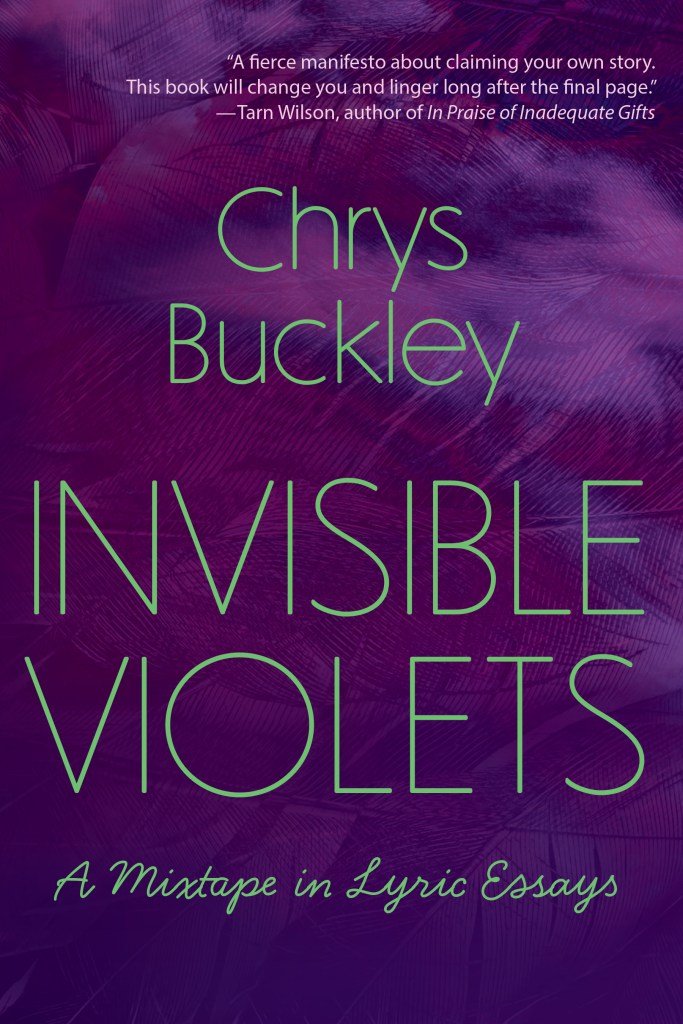
Cover image of Invisible Violets: A Mixtape in Lyric Essays by Chrys Buckley. Words are green against a textured background of different shades of purple. Near the top of the cover, there is an author blurb that reads, "A fierce manifesto about claiming your own story. This book will change you and linger long after the final page." This blurb was written by Tarn Wilson, author of In Praise of Inadequate Gifts.

~~~

For all the book details, check out the INVISIBLE VIOLETS page!

This post is part of a series, published the second Tuesday of every month, where I think about who my book is for.

~Chrys

Image Description: a silhouette of a person with hair flying like they’re head banging, with music symbols in the background, including treble clefs, bass clefs, sharp symbols, flat symbols, and music notes.

Blindness and Disability, Music, My Books, Writing

BACK COVER REVEAL!

First there was the COVER REVEAL.

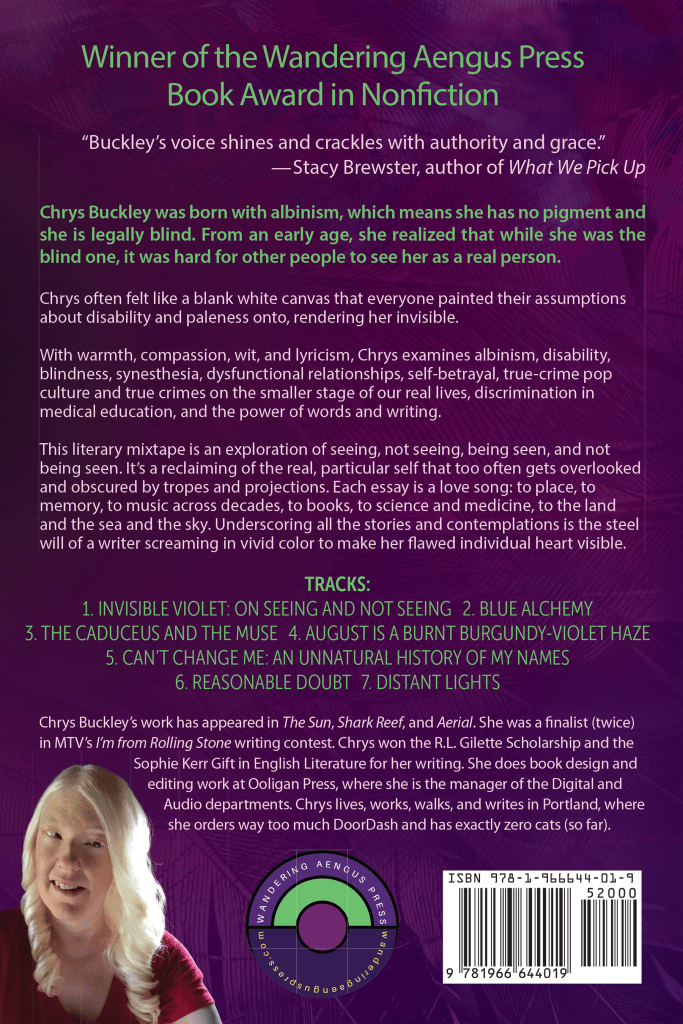
It’s been a minute since then (!) and now it’s time to reveal the back cover of INVISIBLE VIOLETS: A Mixtape in Lyric Essays! You can find book info, including how to pre-order signed and personalized copies here.

With no further ado, here is the back cover:

Back cover of Invisible Violets on a textured purple background
Blindness and Disability, My Books, Writing

If You Have a Disability . . . You Might Like INVISIBLE VIOLETS

array of accessibility icons, including wheelchairs, canes, guide dogs, pregnant people, and question marks for less apparent disabilities

Or if you are disabled.

Or if you’re a person with a disability.

Or if you are living with disability.

Or if you experience disability.

Or if you have lived experience of maybe sometimes possibly experiencing this thing in your life that we all must put lots of words in front of to make it as distant as possible that we maybe sometimes possibly in whispered voices refer to as disability.

Okay, I’m obviously getting a bit over the top with that last one (though it does sometimes feel that way). My point, though, is that no matter what language you use, you are welcome here and you might find resonance in my upcoming debut essay collection, INVISIBLE VIOLETS: A Mixtape in Lyric Essays.

I’ve been thinking a lot lately about who my book is for. It’s going to publish in two months, and so my thinking has had to shift more outward now that all the proofing is done and it’s on its way out into the world. (Yay! And eeeeeeeek!)

The most prominent theme running through my book is disability. So, if you are a disabled reader (or any other particular phrasing that feels right to you), this book is for you.

Even though we all experience disability differently (even if we have the same disability), I hope my words will give you that “oh yes” and “she gets me” sense while reading, a sense I’ve experienced while reading authors who have disability in common with me.

I hope my words will give voice to internal and external dynamics in a way that articulates the specific struggles and joys of disabled life in a way that makes you feel seen and understood, as other books have done for me.

I hope reading my book lights a fire under the part of you that wants to write your own story, if you’re so inclined, because there are so few books about disability by disabled people out there and there’s room for so many more, and we need more.

Not every essay in my collection has disability as its central topic. Sometimes it’s a central theme, and other times it isn’t. Because that reflects reality. Sometimes it’s all-consuming, and other times it’s more like background noise.

Disability as a theme is most prominent in these essays:
Track 1: Invisible Violet: On Seeing and Not Seeing
Track 3: The Caduceus and the Muse
Track 5: Can’t Change Me: An Unnatural History of My Names
Track 6: Reasonable Doubt

Disability is present but more peripheral in these essays:
Track 2: Blue Alchemy
Track 4: August is a Burnt Burgundy-Violet Haze

Our experiences won’t be exactly the same. They might even be wildly different. Either way, I hope there are lines and paragraphs and passages and perhaps whole essays that harmonize with your experience and give you that sense of recognition that sometimes comes with reading.

Cover image of Invisible Violets: A Mixtape in Lyric Essays by Chrys Buckley. Words are green against a textured background of different shades of purple. Near the top of the cover, there is an author blurb that reads, "A fierce manifesto about claiming your own story. This book will change you and linger long after the final page." This blurb was written by Tarn Wilson, author of In Praise of Inadequate Gifts.

~~~

For all the book details, check out the INVISIBLE VIOLETS page!

~Chrys

Image Description: an array of accessibility icons depicting people in wheelchairs, people using canes, people with guide dogs, pregnant people, people with small children, and some questions marks (which I believe represent less apparent disabilities).

Podcasts, Samples, Writing

Writing as Memory Window – Blue Alchemy 2

Sometimes memoir writing transforms your memory. The summer that I was fifteen, my friend Hope, who I’d known for a few years, ran away from blind camp with three guy friends during an overnight camping trip in the woods. They had planned this escape for a year and once they were found, they were all kicked out of camp. I thought I’d never see Hope again. Years later, writing about my summers at blind camp, I wanted to write about this incident but I couldn’t remember how I found out that Hope ran away. I talked with other friends from blind camp but nothing jarred my memory. I started writing about that summer, starting from arriving at Fox Cabin with its blue vinyl couches and orange, white and yellow checked curtains.

As I got closer in the writing to Monday, the night Hope went missing, I decided to just make it up. How I found out wasn’t that important to the overall story, I reasoned. I remembered that our cabin had shucked corn early that afternoon for a cookout we were having that night and I was just going to write in someone coming up to us while we were in the back of the dining hall complaining about the corn. But then, as I wrote into the scene, felt the New Jersey early August heat, remembered the bales of corn, recalled my friend Robyn doing Beavis and Butthead impressions, it suddenly came to me. It was later that afternoon, after we were done with the corn. We were having free swim, frolicking in the L-shaped, cyan-colored pool when Molly, the arts and crafts instructor, called me over to the side of the pool and asked if I knew where Hope might go if she was upset and wanted to get away. That’s how I found out she was missing. Nothing I had tried had helped me remember except writing right into it.

~~~

Here’s another little excerpt from “Blue Alchemy.” Read a previous excerpt here. This is an essay that’s about memoir writing, and how memory and writing both get transformed in the process. And this little snippet is about how the act of writing can help us remember.

Don’t forget you can find other Friday samples here, and you can always read Older Works and Published pieces.

~Chrys

Samples, Writing

Writing as Time Travel – Blue Alchemy 1

Writing about your own past is surreal. You’re reliving it. You’re at Fox Cabin at blind camp with the blue vinyl couches in the living room and the orange, white and yellow checked curtains in the bedrooms. You’re eight years old, unable to sleep because you’re terrified of your parents because Mom was getting hysterical again today and maybe this time she’ll really lose it or Dad’s smoldering rage will erupt, so you’re reading Nancy Drew by the night of your night light. You’re riding King County Metro after being rejected from both blood plasma donation for cash (your temperature was too low) and staying at the Green Tortoise Hostel for work-trade, knowing you only have three days until you and your roommates get evicted. You stare out the window watching as the bus passes through the hilly streets of downtown Seattle, thinking dark thoughts like maybe homelessness would suit you because you’ve always felt like an orphan anyway. You’re skulking by a payphone outside 7-11 in the outskirts of Seattle while your roommate is across the parking lot buying pot. You’re swimming in Puget Sound, not long after sunset, and the water is so cold that you’ve never felt more alive, and it suddenly, truly, deeply feels like all you’ve been through was somehow worth it to be here now, in the water, your limbs feeling heavier as you get closer to shore, and you’re unable to stop looking back at the cerulean dusk and the fading pink on the western horizon.

You’re all of these places but you’re also sitting on your bed writing in your little room with your books and notebooks stacked in milk crates, your window slightly open to let in the sounds of the Orcas ocean and the slow creak of cedar trees swaying in the wind, trying not to think about the boy who lives down the hall from you or the girl in his room. Or you’re writing in the fluffy brown chair in your apartment, wondering if you should get rid of it because your ex-boyfriend left it when he went to jail and do you really need any more reminders of him? But on the other hand it really fits the color scheme of your room and is really comfortable to write in.

In the story you are writing it might be fall while in reality when you are writing it, it’s summer solstice. And yet, the more you write, the more you swear that the light coming in through your windows is so distinctly autumnnal. You can almost smell the foliage.

There is something haunting about being in more than one experience at once. It’s like how it felt when I first came home from college after months of being away. Walking into the living room with its dark blue patterned furniture and light blue pleated blinds felt almost like an out-of-body experience. Everything was always slightly off from what I remembered, like all the colors or the feelings I associated with them had all made the slightest of wavelength shifts on the electromagnetic spectrum, just a few angstroms, nothing you could quite articulate or measure but sense nonetheless. Writing memoir is like that, I’m in two places in time, two times at once, memory and present tense, and they are so distinct and yet so muddled that it’s hard to tell which one I’m living in more.

~~~

For more samples, look here.

This is an excerpt from my most recent piece of writing, a personal essay called “Blue Alchemy,” about writing memoir, and the slipperiness of writing and memory.

~Chrys