 Everywhere you walk, you “get caned”—hit by several canes from all different directions. There are just so many people navigating[1] their way around that it’s impossible to avoid. From the moment you emerge from your room to the time you reenter it, you get caned. There are dogs everywhere too. They are also getting caned at every turn, and surrounded by so many other dogs. I think they are more overwhelmed than the people. The hotel has set aside a place outside for people to relieve their guide dogs but I keep hearing that some of them, especially the ones that have never been to a convention before, are having some bladder issues.
Tag: essay
Know Your Enemy – MMM: In the Trenches of Organic Chemistry 1
 “We’re not literally going to die,” I reminded Natalie as I gathered up my things to leave her apartment and walk back across the street to mine. “I mean, no one’s going to shoot us or anything. The worst that will happen is that we fail–”
“I kinda feel like I might actually fail,” Natalie said, sort of laughing the way people laugh when they’re trying not to cry. I knew that laugh so well by now, had laughed it myself so many times.
I grabbed my huge eight-pound book with the fluorescent green cover and shoved it into my backpack. “Me too,” I admitted. I looked around her living room, to all of our practice tests and answer keys scattered over her couch, chair and coffee table; the erasers bloody with pencil shavings, my pink and purple mechanical pencils and Natalie’s straight-up golden #2s; our notecards in several haphazard piles; our identical molecular models of cyclohexane with their carbons and hydrogens in the most stable chair conformations. Natalie sat on her couch, pulling a plush brown blanket around her shoulders. Her apartment looked like a warzone. “That practice test was brutal,” I said. “I’m the one who couldn’t even finish it.” I had given up early into the second practice test, as per usual, feeling I just didn’t know enough to go forward, every question making me feel more like a failure than the last.
Continue reading “Know Your Enemy – MMM: In the Trenches of Organic Chemistry 1”
Parties
 I am albino, which means my skin and hair are paler than pale, and though I have partial vision, I’m legally blind. I grew up in a town where it seemed everyone worshiped at the same handful of churches and was white and voted Republican and wore the same clothes. I was white, but I was too white. I was an agnostic atheist, a bleeding heart, and I dressed like the grunge-rock musicians I admired. I didn’t even fit in with the delinquent kids, because my parents were too strict and my grades too good. I felt like the town freak.
Nothing emphasized my feelings of alienation like a school dance, where I’d sit at the back of the cafeteria and eat chips to numb myself. One time I tried to mingle, but a girl I’d ridden to the dance with told me to stop following her around like a puppy. I went back to the food table and tried to disappear.
A Good Read: An Essay
 I have tried many times to explain who I am, at all different points in my life. I have used up pages and pages trying to convey all the different and conflicting attributes of my personality. I have used my interests, my reactions to situations, the way I think, what I believe in, some significant experiences, my aspirations, my fears, and my deepest innermost emotions to try to define what makes me who I am and separates me from the rest of the world. I have tried to find what makes me an individual, unique in my own way. Each time I have tried I always have come away feeling that I am too complex to explain, or maybe that I am no different from anyone else.
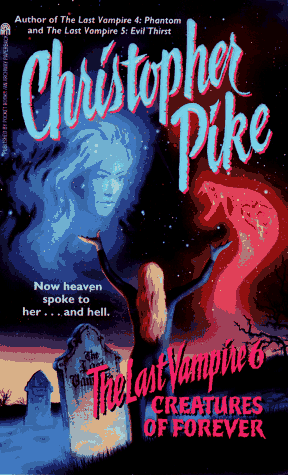
Then, over the course of eighth and ninth grade I read the six-part series by Christopher Pike called The Last Vampire series. They sound like books that are just simple thrillers for young readers, and for someone at a younger age, that is really all they are. However, I read the series earlier this year at a much deeper level and was amazed at what I found. There is really significant material within the lines of the books.
After the first reading, I finished the last book feeling different, but I could not easily put my finger on the reason why. I felt a sense of tranquility that I was unaccustomed to.
Writing as Memory Window – Blue Alchemy 2
Sometimes memoir writing transforms your memory. The summer that I was fifteen, my friend Hope, who I’d known for a few years, ran away from blind camp with three guy friends during an overnight camping trip in the woods. They had planned this escape for a year and once they were found, they were all kicked out of camp. I thought I’d never see Hope again. Years later, writing about my summers at blind camp, I wanted to write about this incident but I couldn’t remember how I found out that Hope ran away. I talked with other friends from blind camp but nothing jarred my memory. I started writing about that summer, starting from arriving at Fox Cabin with its blue vinyl couches and orange, white and yellow checked curtains.
 As I got closer in the writing to Monday, the night Hope went missing, I decided to just make it up. How I found out wasn’t that important to the overall story, I reasoned. I remembered that our cabin had shucked corn early that afternoon for a cookout we were having that night and I was just going to write in someone coming up to us while we were in the back of the dining hall complaining about the corn. But then, as I wrote into the scene, felt the New Jersey early August heat, remembered the bales of corn, recalled my friend Robyn doing Beavis and Butthead impressions, it suddenly came to me. It was later that afternoon, after we were done with the corn. We were having free swim, frolicking in the L-shaped, cyan-colored pool when Molly, the arts and crafts instructor, called me over to the side of the pool and asked if I knew where Hope might go if she was upset and wanted to get away. That’s how I found out she was missing. Nothing I had tried had helped me remember except writing right into it.
~~~
Here’s another little excerpt from “Blue Alchemy.” Read a previous excerpt here. This is an essay that’s about memoir writing, and how memory and writing both get transformed in the process. And this little snippet is about how the act of writing can help us remember.
Don’t forget you can find other Friday samples here, and you can always read Older Works and Published pieces.
~Chrys
Related articles
- Writing as Time-Travel – Blue Alchemy
- The Colors – Dark As Roses
- Albino – Seeing and Not Seeing 2
- Memoir Labyrinth – Write Through Series – Number 1 (wordscomeezine.wordpress.com)
- National Novel Writing Month is here again! (susanscribes.wordpress.com)
For the Love of Seasons – Geomagnetic Imprints and Natal Honing
I have always had a thing for seasons, and it would be dishonest to say that the Pacific Northwest doesn’t have them, but it would only be slightly less untrue to say that it does. Portland, Oregon has seasons the way a Sound (as in Puget or Long Island) has waves: technically it does, but they are small and gentle ripples, and have nothing at all of the power and fury of the wild sea. The seasons of New England obliterate the landscape with a cyclical frequency and a constant intensity that I somehow find very romantic.
 My ache for the extreme seasons I grew up with hasn’t faded, as I thought it might, with more time and conditioning in this more temperate climate; instead, the wanting accumulates. Even though I live on a big hill known for its power outages, impassability in heavy snows and general storm susceptibility, the most winter I’ve seen out my window–invariably on mornings when I have exams in like organic chemistry–only lasts long enough to take some cell phone pictures of the fleeting moment. Every successive winter that passes without significant snow, I feel a little betrayed by Mother Nature, or by myself for having chosen to live somewhere without real winters. I yearn for a good blizzard, the sky before a good snow, so dark it makes the lights inside houses and hallways look warmer, howling wind so gusty it makes the lights go out, months of snow angels and snowmen and forts and snowball fights and hot chocolate and sledding and real bundling up and layers and fires in the fireplace, a coldness and a darkness that seems to permeate everything, grab hold of the Earth and never let go until spring, when the ground would get soggy with all its melting snow. I miss that.
Continue reading “For the Love of Seasons – Geomagnetic Imprints and Natal Honing”
Legends, Fakers and Painterly Writers – On Synesthesia 2
 Some people have synesthetic experiences during seizures or on psychedelic drugs. Some say it’s more prevalent in artistic people. It’s a condition that tends to run in families so it’s believed that there’s a genetic basis. Scientists believe that all babies are synesthetes but as they grow and go through synaptic pruning, the senses fully differentiate in normal development. When I was young, I had a set of colored magnetic letters that loosely correlated with my letter-color perceptions.
Last year, a site called “I Write Like” was posted all over Facebook. The first time I tried it, I was told that my writing style resembles that of Vladimir Nabokov and I was floored by the coincidence. Though I’ve never read any of his work, I learned about his synesthesia while reading Reading Lolita in Tehran by Azar Nafisi. Nabokov described himself as a painterly writer and it was the first time I heard of any writer whose synesthesia informed their work. It was a revelation that at least one other person might have had a similar inner world.
Famous Russian pianist and composer Alexander Scriabin faked synesthesia and created a contrived color-based musical system based on the New Age teachings of Madame Blavatsky, founder of the Theosophical Society, which combined science and esoteric beliefs. The founders of the Theosophical Society timed its inception to intricate calculations of astrological aspects. Numerology was considered sacred and perhaps a musical-number-color system supposedly based on a condition linked with psychedelic shamanic journeys and artistic creations imparted an ethereal quality, icing on the metaphysical cake.
It’s hard to describe the synesthetic experience to someone who doesn’t have it. One woman I used to work with would always ask me what it meant that, for example, 6 was a light blue. What was the underlying, psychic meaning of it? What did the color tell me about the intrinsic feel of the number 6? “It doesn’t tell me anything, it’s just light blue,” I would answer and she would get mad, as if I was ignoring special access to some universal truth.
I am a painterly writer, especially when writing longhand. Each letter is like a specific colored pencil. Colors inform word and phrasing and permeate through all aspects of what I put on the page. In fiction, I pick character names that are aesthetically pleasing in color and sometimes this bleeds over (unconsciously) into real life. A disproportionate amount of my characters, as well as boyfriends and crushes, have had names that start with A or J (red and green, respectively) and that are artistically agreeable in color.
~~~
For today’s writing sample, here’s another sample from the lyric essay “On Synesthesia.” For the first excerpt (the beginning of the essay) click here.
Don’t forget, you can check out other Friday writing samples here. And there’s always the Published and Older Works sections to explore as well.
~Chrys
Related articles
- Seeing Sounds, Hearing Colors: Good for Survival? (history.com)
- Can You Be Taught to Read in Color? (segmation.wordpress.com)
- Do You Hear In Color? (fishofgold.wordpress.com)
Writing as Time Travel – Blue Alchemy 1

Writing about your own past is surreal. You’re reliving it. You’re at Fox Cabin at blind camp with the blue vinyl couches in the living room and the orange, white and yellow checked curtains in the bedrooms. You’re eight years old, unable to sleep because you’re terrified of your parents because Mom was getting hysterical again today and maybe this time she’ll really lose it or Dad’s smoldering rage will erupt, so you’re reading Nancy Drew by the night of your night light. You’re riding King County Metro after being rejected from both blood plasma donation for cash (your temperature was too low) and staying at the Green Tortoise Hostel for work-trade, knowing you only have three days until you and your roommates get evicted. You stare out the window watching as the bus passes through the hilly streets of downtown Seattle, thinking dark thoughts like maybe homelessness would suit you because you’ve always felt like an orphan anyway. You’re skulking by a payphone outside 7-11 in the outskirts of Seattle while your roommate is across the parking lot buying pot. You’re swimming in Puget Sound, not long after sunset, and the water is so cold that you’ve never felt more alive, and it suddenly, truly, deeply feels like all you’ve been through was somehow worth it to be here now, in the water, your limbs feeling heavier as you get closer to shore, and you’re unable to stop looking back at the cerulean dusk and the fading pink on the western horizon.
You’re all of these places but you’re also sitting on your bed writing in your little room with your books and notebooks stacked in milk crates, your window slightly open to let in the sounds of the Orcas ocean and the slow creak of cedar trees swaying in the wind, trying not to think about the boy who lives down the hall from you or the girl in his room. Or you’re writing in the fluffy brown chair in your apartment, wondering if you should get rid of it because your ex-boyfriend left it when he went to jail and do you really need any more reminders of him? But on the other hand it really fits the color scheme of your room and is really comfortable to write in.
In the story you are writing it might be fall while in reality when you are writing it, it’s summer solstice. And yet, the more you write, the more you swear that the light coming in through your windows is so distinctly autumnnal. You can almost smell the foliage.
There is something haunting about being in more than one experience at once. It’s like how it felt when I first came home from college after months of being away. Walking into the living room with its dark blue patterned furniture and light blue pleated blinds felt almost like an out-of-body experience. Everything was always slightly off from what I remembered, like all the colors or the feelings I associated with them had all made the slightest of wavelength shifts on the electromagnetic spectrum, just a few angstroms, nothing you could quite articulate or measure but sense nonetheless. Writing memoir is like that, I’m in two places in time, two times at once, memory and present tense, and they are so distinct and yet so muddled that it’s hard to tell which one I’m living in more.
~~~
For more samples, look here.
This is an excerpt from my most recent piece of writing, a personal essay called “Blue Alchemy,” about writing memoir, and the slipperiness of writing and memory.
~Chrys
Related articles
Albino – Seeing and Not Seeing 2
When I was maybe five years old, my mom was convinced I couldn’t smile right. I studied her mouth as intently as I could, then stretched my own into the same shape. But one lip or the other was always too high up, too pulled down, turned too far in or out. I tried to work these corrections into my face muscles but I could never see my mom’s smile in enough detail to craft my own to look like everyone else’s.
I have albinism, a recessive genetic condition that results in skin, hair and eyes that are paler than pale, and legal blindness. An enzyme called tyrosinase that converts the amino acid tyrosine into melanin pigment is inactive in albinism and this leads to the whiteness and blindness. The visual impairment of albinism, though steady and consistent, is murky territory—I’m too blind to drive or read any of the letters on a standard eye chart except that top “E” but not so blind that the world isn’t intensely, sensually, visual. In the blind community, I am what they call a “high partial.”
Around the same time as smile training, my blindness was a dull but ever-present emotional ache. On the playground, kids ran up to me and called out “whitey” and “snowball” and “ghost,” waved their hands in the air and asked me how many fingers they were holding up, mimicked my ambling eyes. As I got older, the teasing involved spitballs, a kid who jumped out in front of me in the hallways and yelled, “Watch out, brick wall!” and the boys in eighth grade who stole books out of my locker and set them on fire.
Sometimes, in my room, away from the teasing by my peers but alone with the scenes replaying in my head, the ache would erupt into a scalding, white-hot rage. It was so unfair that out of all the people I knew in my family, in school and around town, I was the one who ended up albino. No one saw anything beyond my albinism. I felt like a ghost.
~~~
Another sample from my essay “Seeing and Not Seeing.” Here’s the previous excerpt from the same essay. I have to say, this piece above is the very beginning. The essay doesn’t end in this same place or mindset.
~Chrys
Related articles
What Color is Your Eight? – On Synesthesia 1
The color of the number 8 is a purply violet-black but not a bright violet, more dull. It’s almost more of a vibration than a color. August is similar but darker, almost burnt and yet more radiant. The letters D and P are both green but D is pale sage while P is an intense forest green. Tuesday is a muted cerulean blue.

Synesthesia is a condition in which one sense evokes another, habitually and involuntarily. Some synesthetes sense different tastes with musical keys, feel “personalities” for different days of the week, or perceive months as having specific spatial locations (“November is two feet to the right”) but the most common form is color-grapheme synesthesia, where letters and numbers have immediate, unchanging color associations. This is the form of synesthesia I experience, as well as colors for months and days of the week that in some cases do, and in some don’t, relate to their letters or numbers.
In his bestselling Musicophilia: Tales of Music and the Brain, Oliver Sacks explores synesthesia, musical and otherwise. He describes psychologist Patrick Ehlen’s early experience of saying aloud to his first-grade class that he was “counting the colors until Friday,” to which the class burst out laughing.
One day in third grade, my class was talking about colors and feelings. The teacher asked everyone what color we thought anger was and everyone said “red.” Of course it was. Vowels and first letters set the tone for the word and A is a rich, deep red. Then she asked us what color sad was, and the rest of the class said “blue” as I started to say “red.” Sad has that deep red A and the S, a duller shade of red. Most people thought of being sad as “having the blues,” but for me it was as deep a red as melancholy. It was the first time I remember being conscious that others didn’t see these colors.
~~~
This is an excerpt from “On Synesthesia,” a lyric essay I wrote about, you guessed it, synesthesia.
You can check out other Friday Samples here. And don’t forget you can always check out Published and Older Works for more samples.
~Chrys
Next Up: Legends, Fakers and Painterly Writers – On Synesthesia 2
Related articles
- Ocean Reverie
- The Colors – Dark As Roses
- Reading Eyes and Faces – Seeing and Not Seeing
- Possibilities – Blind Conventions
- My Face
- Synesthesia – Sensory Confusion, or…? dVerse Meeting the Bar
- WakingTime – Christina Sarich – Synesthesia: A Multidimensional Blur Of The Senses – 1 June 2013
- “Synesthesia”
 Chrys Buckley