Samples, Science, Writing

Know Your Enemy – MMM: In the Trenches of Organic Chemistry 1

ecology background: chemical formulas         “We’re not literally going to die,” I reminded Natalie as I gathered up my things to leave her apartment and walk back across the street to mine. “I mean, no one’s going to shoot us or anything. The worst that will happen is that we fail–”

“I kinda feel like I might actually fail,” Natalie said, sort of laughing the way people laugh when they’re trying not to cry. I knew that laugh so well by now, had laughed it myself so many times.

I grabbed my huge eight-pound book with the fluorescent green cover and shoved it into my backpack. “Me too,” I admitted. I looked around her living room, to all of our practice tests and answer keys scattered over her couch, chair and coffee table; the erasers bloody with pencil shavings, my pink and purple mechanical pencils and Natalie’s straight-up golden #2s; our notecards in several haphazard piles; our identical molecular models of cyclohexane with their carbons and hydrogens in the most stable chair conformations. Natalie sat on her couch, pulling a plush brown blanket around her shoulders. Her apartment looked like a warzone. “That practice test was brutal,” I said. “I’m the one who couldn’t even finish it.” I had given up early into the second practice test, as per usual, feeling I just didn’t know enough to go forward, every question making me feel more like a failure than the last.

Continue reading “Know Your Enemy – MMM: In the Trenches of Organic Chemistry 1”

Samples, Writing

Parties

partiesindexI am albino, which means my skin and hair are paler than pale, and though I have partial vision, I’m legally blind. I grew up in a town where it seemed everyone worshiped at the same handful of churches and was white and voted Republican and wore the same clothes. I was white, but I was too white. I was an agnostic atheist, a bleeding heart, and I dressed like the grunge-rock musicians I admired. I didn’t even fit in with the delinquent kids, because my parents were too strict and my grades too good. I felt like the town freak.

Nothing emphasized my feelings of alienation like a school dance, where I’d sit at the back of the cafeteria and eat chips to numb myself. One time I tried to mingle, but a girl I’d ridden to the dance with told me to stop following her around like a puppy. I went back to the food table and tried to disappear.

Continue reading “Parties”

Samples, Writing

A Good Read: An Essay

519546I have tried many times to explain who I am, at all different points in my life. I have used up pages and pages trying to convey all the different and conflicting attributes of my personality. I have used my interests, my reactions to situations, the way I think, what I believe in, some significant experiences, my aspirations, my fears, and my deepest innermost emotions to try to define what makes me who I am and separates me from the rest of the world. I have tried to find what makes me an individual, unique in my own way. Each time I have tried I always have come away feeling that I am too complex to explain, or maybe that I am no different from anyone else.

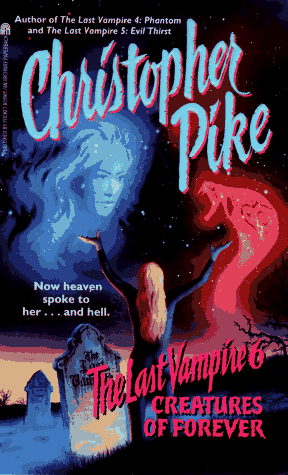
Then, over the course of eighth and ninth grade I read the six-part series by Christopher Pike called The Last Vampire series. They sound like books that are just simple thrillers for young readers, and for someone at a younger age, that is really all they are. However, I read the series earlier this year at a much deeper level and was amazed at what I found. There is really significant material within the lines of the books.

After the first reading, I finished the last book feeling different, but I could not easily put my finger on the reason why. I felt a sense of tranquility that I was unaccustomed to.

Continue reading “A Good Read: An Essay”

Podcasts, Samples, Writing

Writing as Memory Window – Blue Alchemy 2

Sometimes memoir writing transforms your memory. The summer that I was fifteen, my friend Hope, who I’d known for a few years, ran away from blind camp with three guy friends during an overnight camping trip in the woods. They had planned this escape for a year and once they were found, they were all kicked out of camp. I thought I’d never see Hope again. Years later, writing about my summers at blind camp, I wanted to write about this incident but I couldn’t remember how I found out that Hope ran away. I talked with other friends from blind camp but nothing jarred my memory. I started writing about that summer, starting from arriving at Fox Cabin with its blue vinyl couches and orange, white and yellow checked curtains.

As I got closer in the writing to Monday, the night Hope went missing, I decided to just make it up. How I found out wasn’t that important to the overall story, I reasoned. I remembered that our cabin had shucked corn early that afternoon for a cookout we were having that night and I was just going to write in someone coming up to us while we were in the back of the dining hall complaining about the corn. But then, as I wrote into the scene, felt the New Jersey early August heat, remembered the bales of corn, recalled my friend Robyn doing Beavis and Butthead impressions, it suddenly came to me. It was later that afternoon, after we were done with the corn. We were having free swim, frolicking in the L-shaped, cyan-colored pool when Molly, the arts and crafts instructor, called me over to the side of the pool and asked if I knew where Hope might go if she was upset and wanted to get away. That’s how I found out she was missing. Nothing I had tried had helped me remember except writing right into it.

~~~

Here’s another little excerpt from “Blue Alchemy.” Read a previous excerpt here. This is an essay that’s about memoir writing, and how memory and writing both get transformed in the process. And this little snippet is about how the act of writing can help us remember.

Don’t forget you can find other Friday samples here, and you can always read Older Works and Published pieces.

~Chrys

Podcasts, Samples, Writing

For the Love of Seasons – Geomagnetic Imprints and Natal Honing

I have always had a thing for seasons, and it would be dishonest to say that the Pacific Northwest doesn’t have them, but it would only be slightly less untrue to say that it does. Portland, Oregon has seasons the way a Sound (as in Puget or Long Island) has waves: technically it does, but they are small and gentle ripples, and have nothing at all of the power and fury of the wild sea. The seasons of New England obliterate the landscape with a cyclical frequency and a constant intensity that I somehow find very romantic.

My ache for the extreme seasons I grew up with hasn’t faded, as I thought it might, with more time and conditioning in this more temperate climate; instead, the wanting accumulates. Even though I live on a big hill known for its power outages, impassability in heavy snows and general storm susceptibility, the most winter I’ve seen out my window–invariably on mornings when I have exams in like organic chemistry–only lasts long enough to take some cell phone pictures of the fleeting moment. Every successive winter that passes without significant snow, I feel a little betrayed by Mother Nature, or by myself for having chosen to live somewhere without real winters. I yearn for a good blizzard, the sky before a good snow, so dark it makes the lights inside houses and hallways look warmer, howling wind so gusty it makes the lights go out, months of snow angels and snowmen and forts and snowball fights and hot chocolate and sledding and real bundling up and layers and fires in the fireplace, a coldness and a darkness that seems to permeate everything, grab hold of the Earth and never let go until spring, when the ground would get soggy with all its melting snow. I miss that.

Continue reading “For the Love of Seasons – Geomagnetic Imprints and Natal Honing”

Samples, Writing

Writing as Time Travel – Blue Alchemy 1

Writing about your own past is surreal. You’re reliving it. You’re at Fox Cabin at blind camp with the blue vinyl couches in the living room and the orange, white and yellow checked curtains in the bedrooms. You’re eight years old, unable to sleep because you’re terrified of your parents because Mom was getting hysterical again today and maybe this time she’ll really lose it or Dad’s smoldering rage will erupt, so you’re reading Nancy Drew by the night of your night light. You’re riding King County Metro after being rejected from both blood plasma donation for cash (your temperature was too low) and staying at the Green Tortoise Hostel for work-trade, knowing you only have three days until you and your roommates get evicted. You stare out the window watching as the bus passes through the hilly streets of downtown Seattle, thinking dark thoughts like maybe homelessness would suit you because you’ve always felt like an orphan anyway. You’re skulking by a payphone outside 7-11 in the outskirts of Seattle while your roommate is across the parking lot buying pot. You’re swimming in Puget Sound, not long after sunset, and the water is so cold that you’ve never felt more alive, and it suddenly, truly, deeply feels like all you’ve been through was somehow worth it to be here now, in the water, your limbs feeling heavier as you get closer to shore, and you’re unable to stop looking back at the cerulean dusk and the fading pink on the western horizon.

You’re all of these places but you’re also sitting on your bed writing in your little room with your books and notebooks stacked in milk crates, your window slightly open to let in the sounds of the Orcas ocean and the slow creak of cedar trees swaying in the wind, trying not to think about the boy who lives down the hall from you or the girl in his room. Or you’re writing in the fluffy brown chair in your apartment, wondering if you should get rid of it because your ex-boyfriend left it when he went to jail and do you really need any more reminders of him? But on the other hand it really fits the color scheme of your room and is really comfortable to write in.

In the story you are writing it might be fall while in reality when you are writing it, it’s summer solstice. And yet, the more you write, the more you swear that the light coming in through your windows is so distinctly autumnnal. You can almost smell the foliage.

There is something haunting about being in more than one experience at once. It’s like how it felt when I first came home from college after months of being away. Walking into the living room with its dark blue patterned furniture and light blue pleated blinds felt almost like an out-of-body experience. Everything was always slightly off from what I remembered, like all the colors or the feelings I associated with them had all made the slightest of wavelength shifts on the electromagnetic spectrum, just a few angstroms, nothing you could quite articulate or measure but sense nonetheless. Writing memoir is like that, I’m in two places in time, two times at once, memory and present tense, and they are so distinct and yet so muddled that it’s hard to tell which one I’m living in more.

~~~

For more samples, look here.

This is an excerpt from my most recent piece of writing, a personal essay called “Blue Alchemy,” about writing memoir, and the slipperiness of writing and memory.

~Chrys

Blindness and Disability, Samples, Writing

Albino – Seeing and Not Seeing 2

When I was maybe five years old, my mom was convinced I couldn’t smile right. I studied her mouth as intently as I could, then stretched my own into the same shape. But one lip or the other was always too high up, too pulled down, turned too far in or out. I tried to work these corrections into my face muscles but I could never see my mom’s smile in enough detail to craft my own to look like everyone else’s.

Crystal Structures of Tyrosinase

I have albinism, a recessive genetic condition that results in skin, hair and eyes that are paler than pale, and legal blindness. An enzyme called tyrosinase that converts the amino acid tyrosine into melanin pigment is inactive in albinism and this leads to the whiteness and blindness. The visual impairment of albinism, though steady and consistent, is murky territory—I’m too blind to drive or read any of the letters on a standard eye chart except that top “E” but not so blind that the world isn’t intensely, sensually, visual. In the blind community, I am what they call a “high partial.”

Around the same time as smile training, my blindness was a dull but ever-present emotional ache. On the playground, kids ran up to me and called out “whitey” and “snowball” and “ghost,” waved their hands in the air and asked me how many fingers they were holding up, mimicked my ambling eyes. As I got older, the teasing involved spitballs, a kid who jumped out in front of me in the hallways and yelled, “Watch out, brick wall!” and the boys in eighth grade who stole books out of my locker and set them on fire.

Sometimes, in my room, away from the teasing by my peers but alone with the scenes replaying in my head, the ache would erupt into a scalding, white-hot rage. It was so unfair that out of all the people I knew in my family, in school and around town, I was the one who ended up albino. No one saw anything beyond my albinism. I felt like a ghost.

~~~

Another sample from my essay “Seeing and Not Seeing.” Here’s the previous excerpt from the same essay. I have to say, this piece above is the very beginning. The essay doesn’t end in this same place or mindset.

~Chrys

Blindness and Disability, Samples, Writing

Reading Eyes and Faces – Seeing and Not Seeing 1

eyeimagesAnd faces—nothing has given me more trouble. Eyes, those most important details of a face, are too small to make out unless I am close enough to make out with someone. I didn’t know what color my last boyfriend’s eyes were until after we had been dating for almost six months. Whenever we were close enough for me to discern their color, he kept his eyes closed. I didn’t see his eyes until we were riding a city bus on our way to a concert on an early May evening, squished next to each other on the seats. He turned slightly to me, the light was just right, and I finally saw out of my right eye that his left was brown with textured traces of gold, simultaneously soft and hard in color.

Last year, I was watching TV on my 24-inch computer monitor, sitting less than a foot away, and saw a close-up of someone rolling her eyes. At thirty, I was seeing that gesture for the first time and it was nothing like I had imagined. Inspired, I wanted to get a glimmer of what it is to read feelings in eyes, so I watched Grey’s Anatomy, scrutinizing characters during emotionally wrought scenes, their faces taking up my whole screen. Though I felt all the feelings from the context, the music, the minute changes in pitch and inflection in their voices and the larger facial gestures, I could see nothing in the eyes.

~~~

This is an excerpt from an essay in which I explore a few different aspects of albinism and blindness.

You can check out other Friday Samples here. And don’t forget you can always check out Published and Older Works for more samples.

~Chrys

Blindness and Disability, Samples, Writing

Possibilities – Blind Conventions 1

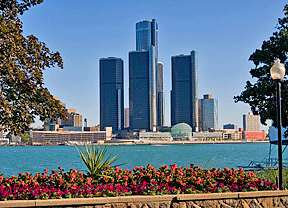
NFB Convention, Detroit 2009

The first few days of convention are filled with Division meetings, meaning that instead of meeting as a huge assembly (that will come later), at any given time there are several different special interest groups meeting at once. Parents of blind children, blind parents, seniors, diabetics, piano tuners, ham radio operators, lawyers, antique car enthusiasts, crafters, technology buffs, they all have divisions and meetings. There are also meetings for new members, presentations from different schools for the blind, presentations by guide dog schools where you can “test drive” a guide dog, meetings on how to build up local chapters, demos of new adaptive technology, plays put on where the directors and actors are all blind, salsa dance classes taught, attended and deejayed by blind folks, a mock trial put on by blind lawyers and the list goes on. We take frequent breaks in our room because the stories are true, it is a little overwhelming.

There’s also the Independence Market, a technology and adaptive aid exhibit hall in one of the hotel ballrooms and it is something to behold. Along every inch of every wall, and through several makeshift hallways in the center, there are endless tables and displays, each draped in a different company logo. Most of the booths feature technology items—braille notetakers, digital book readers, screen-reading software packages, handheld iPhone-shaped gadgets that act as magnifiers and also play music and videos. Apple is there with the real iPhones, which are accessible right out of the box, the new technology rage among the blind. There are several flavors of talking medical supplies, every size and shape of magnifier and audible GPS devices. There are random non-techie booths, like the FBI doing job recruiting, and a booth selling Braille Bibles brailled in over 27 languages, including several Indian ones like Hindi and Malayalam.

I go by myself to the science and engineering division meeting, where I meet people who are interning for NASA and a totally blind girl who’s majoring in biochemistry who guesses people’s heights (while they are sitting down) by voice. Even though I’m slightly slouching, she guesses my 5’7” spot on. The NASA thing gets me. When I was younger, I thought I wanted to do something like that when I grew up, but back then my visual impairment would have been a deal-breaker. That’s one of the great things about a convention like this: you get to really see that things are changing, that blind people are making inroads and finding success in all kinds of careers and hobbies.

~~~

This is an excerpt from the essay “Blind Conventions,” a recounting of my first experience at a blind convention held by the NFB. This piece is apropos because I’m currently en route to my 2nd NFB convention. I’m sure there will be lots of fun crazy, funny, weird and inspiring stories that I’ll be tweeting along the way! These conventions are always surreal.

You can check out other Friday Samples here. And don’t forget you can always check out Published and Older Works for more samples.

~Chrys

Blindness and Disability, Samples, Writing

My Face

I can’t read the nuances of faces but mine is a direct display of every undulation in my emotional current. My face is a one-way mirror.

Still, others often don’t see my personal, particular face.

People sometimes asked if my albino friend and I were twins. We were nine years apart and my face was longer, drawn while hers was rounder, more full. Worse yet, at an albinism conference, my dad came up to the girl next to me and told her it was time to go, mistaking her for me.

My face is at once expressive, transparent and invisible.

~~~

This is from a class I took called Personal Essay Writing. The assignment was to write about your face in EXACTLY 100 words. No more, no less. It led to a lot of obsessive editing.

You can check out other Friday Samples here. And don’t forget you can always check out Published and Older Works for more samples.

~Chrys