Blindness and Disability, Samples, Writing

Albino – Seeing and Not Seeing 2

When I was maybe five years old, my mom was convinced I couldn’t smile right. I studied her mouth as intently as I could, then stretched my own into the same shape. But one lip or the other was always too high up, too pulled down, turned too far in or out. I tried to work these corrections into my face muscles but I could never see my mom’s smile in enough detail to craft my own to look like everyone else’s.
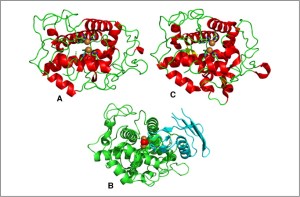
Crystal Structures of Tyrosinase

I have albinism, a recessive genetic condition that results in skin, hair and eyes that are paler than pale, and legal blindness. An enzyme called tyrosinase that converts the amino acid tyrosine into melanin pigment is inactive in albinism and this leads to the whiteness and blindness. The visual impairment of albinism, though steady and consistent, is murky territory—I’m too blind to drive or read any of the letters on a standard eye chart except that top “E” but not so blind that the world isn’t intensely, sensually, visual. In the blind community, I am what they call a “high partial.”

Around the same time as smile training, my blindness was a dull but ever-present emotional ache. On the playground, kids ran up to me and called out “whitey” and “snowball” and “ghost,” waved their hands in the air and asked me how many fingers they were holding up, mimicked my ambling eyes. As I got older, the teasing involved spitballs, a kid who jumped out in front of me in the hallways and yelled, “Watch out, brick wall!” and the boys in eighth grade who stole books out of my locker and set them on fire.

Sometimes, in my room, away from the teasing by my peers but alone with the scenes replaying in my head, the ache would erupt into a scalding, white-hot rage. It was so unfair that out of all the people I knew in my family, in school and around town, I was the one who ended up albino. No one saw anything beyond my albinism. I felt like a ghost.

~~~

Another sample from my essay “Seeing and Not Seeing.” Here’s the previous excerpt from the same essay. I have to say, this piece above is the very beginning. The essay doesn’t end in this same place or mindset.

~Chrys

Blindness and Disability, Samples, Writing

Reading Eyes and Faces – Seeing and Not Seeing 1

eyeimagesAnd faces—nothing has given me more trouble. Eyes, those most important details of a face, are too small to make out unless I am close enough to make out with someone. I didn’t know what color my last boyfriend’s eyes were until after we had been dating for almost six months. Whenever we were close enough for me to discern their color, he kept his eyes closed. I didn’t see his eyes until we were riding a city bus on our way to a concert on an early May evening, squished next to each other on the seats. He turned slightly to me, the light was just right, and I finally saw out of my right eye that his left was brown with textured traces of gold, simultaneously soft and hard in color.

Last year, I was watching TV on my 24-inch computer monitor, sitting less than a foot away, and saw a close-up of someone rolling her eyes. At thirty, I was seeing that gesture for the first time and it was nothing like I had imagined. Inspired, I wanted to get a glimmer of what it is to read feelings in eyes, so I watched Grey’s Anatomy, scrutinizing characters during emotionally wrought scenes, their faces taking up my whole screen. Though I felt all the feelings from the context, the music, the minute changes in pitch and inflection in their voices and the larger facial gestures, I could see nothing in the eyes.

~~~

This is an excerpt from an essay in which I explore a few different aspects of albinism and blindness.

You can check out other Friday Samples here. And don’t forget you can always check out Published and Older Works for more samples.

~Chrys

Blindness and Disability, Samples, Writing

Possibilities – Blind Conventions 1

NFB Convention, Detroit 2009

The first few days of convention are filled with Division meetings, meaning that instead of meeting as a huge assembly (that will come later), at any given time there are several different special interest groups meeting at once. Parents of blind children, blind parents, seniors, diabetics, piano tuners, ham radio operators, lawyers, antique car enthusiasts, crafters, technology buffs, they all have divisions and meetings. There are also meetings for new members, presentations from different schools for the blind, presentations by guide dog schools where you can “test drive” a guide dog, meetings on how to build up local chapters, demos of new adaptive technology, plays put on where the directors and actors are all blind, salsa dance classes taught, attended and deejayed by blind folks, a mock trial put on by blind lawyers and the list goes on. We take frequent breaks in our room because the stories are true, it is a little overwhelming.

There’s also the Independence Market, a technology and adaptive aid exhibit hall in one of the hotel ballrooms and it is something to behold. Along every inch of every wall, and through several makeshift hallways in the center, there are endless tables and displays, each draped in a different company logo. Most of the booths feature technology items—braille notetakers, digital book readers, screen-reading software packages, handheld iPhone-shaped gadgets that act as magnifiers and also play music and videos. Apple is there with the real iPhones, which are accessible right out of the box, the new technology rage among the blind. There are several flavors of talking medical supplies, every size and shape of magnifier and audible GPS devices. There are random non-techie booths, like the FBI doing job recruiting, and a booth selling Braille Bibles brailled in over 27 languages, including several Indian ones like Hindi and Malayalam.

I go by myself to the science and engineering division meeting, where I meet people who are interning for NASA and a totally blind girl who’s majoring in biochemistry who guesses people’s heights (while they are sitting down) by voice. Even though I’m slightly slouching, she guesses my 5’7” spot on. The NASA thing gets me. When I was younger, I thought I wanted to do something like that when I grew up, but back then my visual impairment would have been a deal-breaker. That’s one of the great things about a convention like this: you get to really see that things are changing, that blind people are making inroads and finding success in all kinds of careers and hobbies.

~~~

This is an excerpt from the essay “Blind Conventions,” a recounting of my first experience at a blind convention held by the NFB. This piece is apropos because I’m currently en route to my 2nd NFB convention. I’m sure there will be lots of fun crazy, funny, weird and inspiring stories that I’ll be tweeting along the way! These conventions are always surreal.

You can check out other Friday Samples here. And don’t forget you can always check out Published and Older Works for more samples.

~Chrys

Blindness and Disability, Samples, Writing

My Face

I can’t read the nuances of faces but mine is a direct display of every undulation in my emotional current. My face is a one-way mirror.

Still, others often don’t see my personal, particular face.

People sometimes asked if my albino friend and I were twins. We were nine years apart and my face was longer, drawn while hers was rounder, more full. Worse yet, at an albinism conference, my dad came up to the girl next to me and told her it was time to go, mistaking her for me.

My face is at once expressive, transparent and invisible.

~~~

This is from a class I took called Personal Essay Writing. The assignment was to write about your face in EXACTLY 100 words. No more, no less. It led to a lot of obsessive editing.

You can check out other Friday Samples here. And don’t forget you can always check out Published and Older Works for more samples.

~Chrys